
The Smith Inheritance: What do the Masonic Lodge and the Mormon Temple have in common?
The Day I Stopped Believing

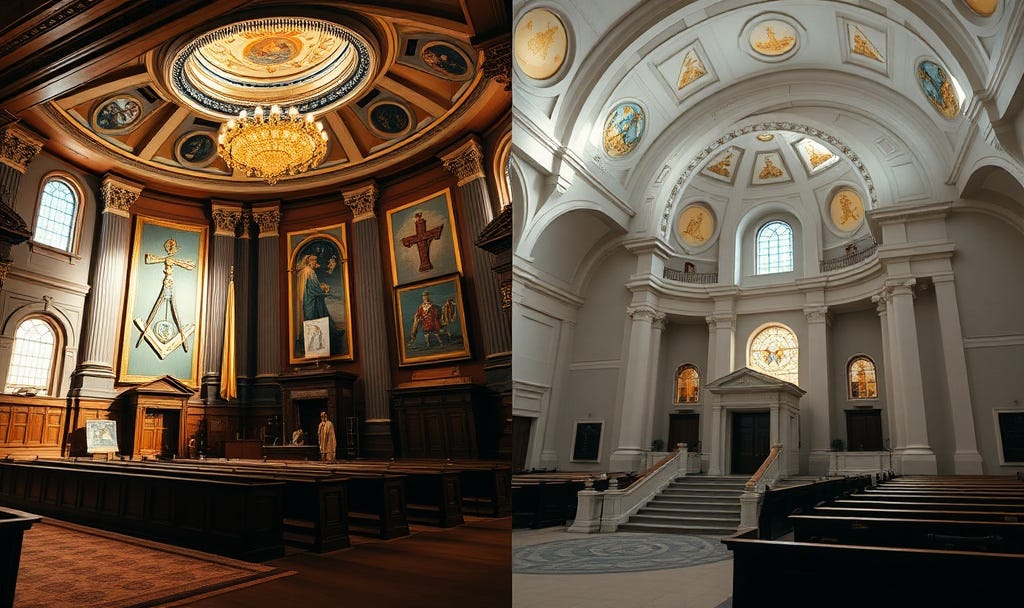
I grew up knowing I was descended from people who had seen God.
In the flesh. Not metaphorically. Not as a figure of speech. As a Smith, I was raised with the family understanding that Joseph Smith Jr. had spoken with the Almighty personally, received golden plates from an angel, and restored the only true church on earth. My great-great-grandfather, Samuel, was Joseph’s younger brother, the first to be baptized and one of the Eight Witnesses who signed their names at the front of the Book of Mormon. We were not merely members of the faith. We were its original material.
Now I was standing outside the Salt Lake City Temple while my little sister got married inside. Barred from joining my family to witness her wedding because I wasn’t deemed worthy enough to attend.
Since I had left the Mormon faith, I no longer qualified as an upstanding, tithing-paying Mormon, a requirement for entrance.
Anger burned in my chest as I waited. I had been shattered at nineteen when I discovered that the sacred temple marriage ceremony, the holiest rite in Mormonism, had been borrowed from a fraternal lodge that Joseph joined seven weeks before he introduced it to his followers as revelation from God.
He lied.
Seven weeks after becoming a Freemason, Joseph Smith introduced those same rituals to his followers as divine revelation. And yet I was the one considered unworthy to stand with my family. Deemed unworthy by a liar.
Sit with the timeline: Seven weeks after becoming a Freemason, Joseph Smith got a revelation of Mormon Temple rituals that just happened to be almost identical to the Freemason initiation rituals.
The timeline is not disputed, not even by the Mormon Church itself.
On March 15, 1842, Joseph Smith received the first degree in Freemasonry in the Nauvoo Lodge, assembled in his general business office. The following day he rose to the sublime degree, becoming a Master Mason. On May 4–5, 1842, mere weeks after obtaining the Masonic rituals, Smith introduced the LDS endowment ceremony to close friends, including nearly identical tokens, signs, penalties, prayer circle, new name ritual, and apron.
Those penalties were not abstract. The original ceremony required participants to physically mime their own execution, throat slitting, heart removal, and disembowelment, as the price of revealing what they had witnessed.
The Church quietly removed these gestures in 1990. For generations before that, members performed them without ever having been told, before they arrived at the ceremony, what they were agreeing to. The secrecy was enforced from inside the ritual itself.
I was raised to believe those ceremonies were ancient. Eternal. Based on the original ceremonies in King Solomon’s Temple. Kept, as the Doctrine and Covenants puts it, “hid from before the foundations of the earth.” My mother and my sisters let strangers anoint their bodies’ private parts with oil and whisper a new name to them through a veil, and I was told this was sacred and holy.
It wasn’t holiness I was missing. It was information.
“There is absolutely no question in my mind that the Mormon ceremony which came to be known as the Endowment, introduced by Joseph Smith to Mormon Masons, had an immediate inspiration from Masonry.” — Dr. Reed Durham, LDS Historian, 1974
Durham was not an anti-Mormon critic. He was the director of the LDS Institute of Religion, delivering his findings at a Mormon History Association conference, and the blowback he received from Church leadership afterward was, to put it diplomatically, considerable.
Masonic author Mervin Hogan observed that Mormonism and Freemasonry are so intimately and inextricably interwoven that the two can never be dissociated.
Even the Church’s own scholars have acknowledged the connection, if carefully. Apostle Heber C. Kimball, himself a Mason and a member of the original Quorum of the Twelve, wrote to fellow Apostle Parley Pratt in 1842 that there was “a similarity of priesthood in Masonry,” and that Joseph said Masonry had been “taken from priesthood but has become degenerated.”
This was Joseph’s explanation: that Masonry was a corrupted remnant of the ancient priesthood, and that he was restoring the original. He had found the degenerated version in a lodge in Illinois and purified it through revelation.
I have spent considerable time sitting with the audacity of this explanation, and I have to admit, as someone raised on Joseph’s particular brand of theological confidence, that it has a certain grandeur to it. The man could sell a story. I come from people who bought it for generations. I cannot be entirely unsympathetic.
But the story stopped working for me the day I learned the timeline.
What I lost was the specific claim, the one that justified the secrecy, the coercion, the shame, the bodies of young girls and boys anointed by strangers, that this had come from God. It had come from a lodge in Nauvoo, Illinois. On March 15, 1842. Seven weeks before God revealed it.
So, there I stood outside the Salt Lake Temple, waiting for the family photograph. The one where everyone smiles in their wedding best and the bride glows and the moment looks like what a wedding is supposed to look like.
My sister and I were close, so I pulled her aside afterward, and told her how painful it had been to be excluded. To stand outside while my own family celebrated inside.
She looked at me with genuine puzzlement. “Since you weren’t Mormon anymore,” she said, “why would you even want to be there?”
She wasn’t being cruel. That was the most devastating part. She had been so thoroughly shaped by the institution that the ordinary human logic of weddings, that they are for everyone who loves the people being married, had been replaced by a membership requirement. She couldn’t feel what she couldn’t see. And the Church had made sure she couldn’t see it.
None of my Mormon family understood why I was upset. Which made me feel even more invisible than standing outside the temple had.
I am a great-great-grandniece of the Smith family. I carry that name and that legacy and the complicated inheritance of being descended from people who built something damaging and harmful. I do not write about this to wound the faithful. I write about it because I was faithful and was not told the truth, and that withholding shaped the first decades of my life in ways I am still mapping.
This is what The Smith Inheritance is for. The things we were never supposed to say out loud. The secrets. The truth.
We’re saying them now.
Have you ever been excluded from a family event — a wedding, a funeral, a celebration — because you left a belief, a religion, a marriage, or a way of life? What did it cost you to stand outside that door?
And paid subscribers — what’s the piece of your own inheritance you were never supposed to examine? The family secret, the institutional lie, the history that was kept from you until you found it yourself? Tell me in the comments. That’s what The Smith Inheritance is built for.
Hit reply. I read every one.